


Abstract
This article explores the feasibility of using composite reinforcement in the design of driven concrete piles with solid square cross-sections. It presents the results of calculations for safety factors of short-term strength in concrete driven piles reinforced with fiberglass composite rebar during transportation. Both analytical and experimental studies were conducted to assess the impact of reinforcement type on strength and stiffness during unloading. A strong correlation was identified between the maximum allowable force and its orientation during pile pressing. The article also includes results of trial pile driving using composite-reinforced piles. It was found that the performance of piles reinforced with composite rebar is comparable to that of piles reinforced with traditional steel rebar. An economic effect was identified, showing that replacing steel reinforcement with composite reinforcement reduces the final cost of the product (pile).
Stress-strain state of a driven pile reinforced with fiberglass rebar: field of vertical displacements [m]
Stress-strain state of a driven pile reinforced with fiberglass rebar: field of vertical displacements [m]
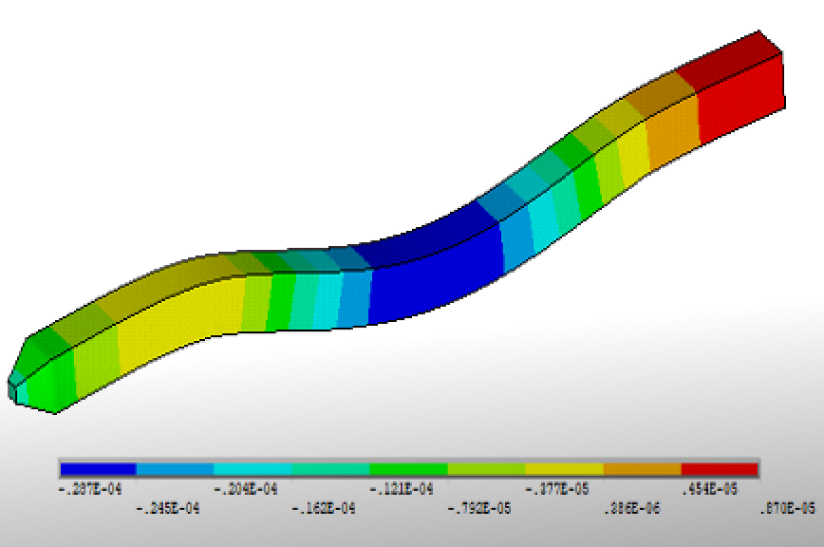
Stress-strain state of a driven pile reinforced with fiberglass rebar: field of vertical displacements [m]
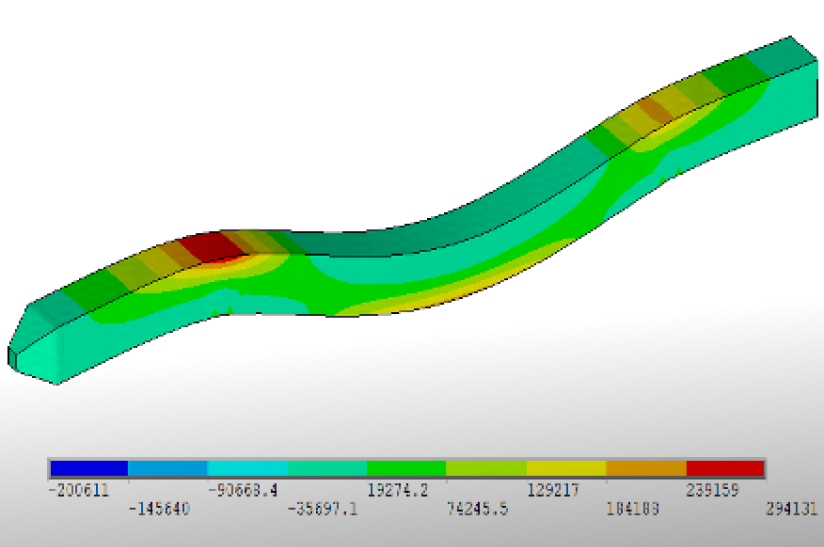
Stress-strain state of a driven pile reinforced with fiberglass rebar: field of vertical displacements [m]
Introduction
The use of piles in soil for building construction and geotechnical applications has been known since ancient times. Today, over 150 types of piles are used in construction practice, with solid square-section driven piles being the most widely adopted. These piles significantly reduce labor intensity, construction costs, and timelines. Traditionally, piles are reinforced with steel rebar, which substantially affects the overall product cost. One way to reduce this cost is by replacing steel with composite reinforcement, such as fiberglass polymer rebar (hereinafter referred to as GFRP).
However, since concrete piles are cast at the manufacturing plant, they require transportation to the construction site. This process increases the risk of mechanical damage, which can lead to cracks, chipping, and exposure of the reinforcement cage. Replacing steel with composite reinforcement increases pile deformability, which raises the likelihood of cracking during transportation, loading and unloading, and pile driving. Such defects can significantly impair the structural performance of the pile.
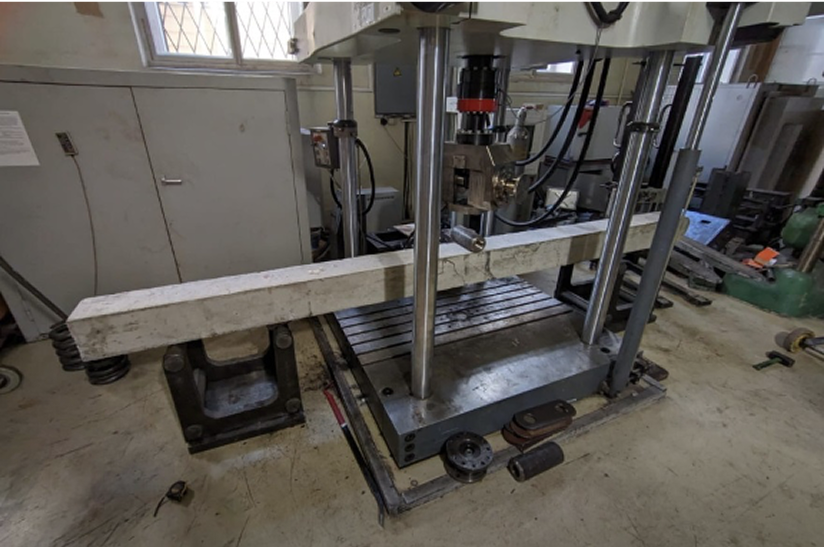
This study presents the results of stress-strain state analysis for piles using finite element solutions of linear boundary value problems in a 3D setup. It also includes results from experimental three-point bending tests in laboratory conditions, field trials of driving piles reinforced with composite rebar, and an economic assessment of replacing steel reinforcement with GFRP.
The object of study was a standard driven concrete pile with a solid square cross-section. Two reinforcement configurations were examined:
-
Type I
steel reinforcement (standard pile model С40.20-3)
-
Type II
fiberglass polymer reinforcement (GFRP)
The concrete piles were manufactured at JSC "TZhBI-4" (Tver, Russia) (see Figures 1 and 2). Table 1 provides the parameters of the steel reinforcement used in pile production. The concrete strength class was B25.
Table 1
Parameters of the Steel Reinforcement Cage
| Pos. | Name | Unit Weight, kg |
Quantity |
Description |
|
Pile С40.20-3 |
||||
|
Parts |
||||
| 1 |
Rod Ø10 AIII L=3958 |
2.44 |
4 | 9.76 kg |
| 2 |
Spiral Ø4 Bpl L=14198 |
1.31 |
1 |
1.31 kg |
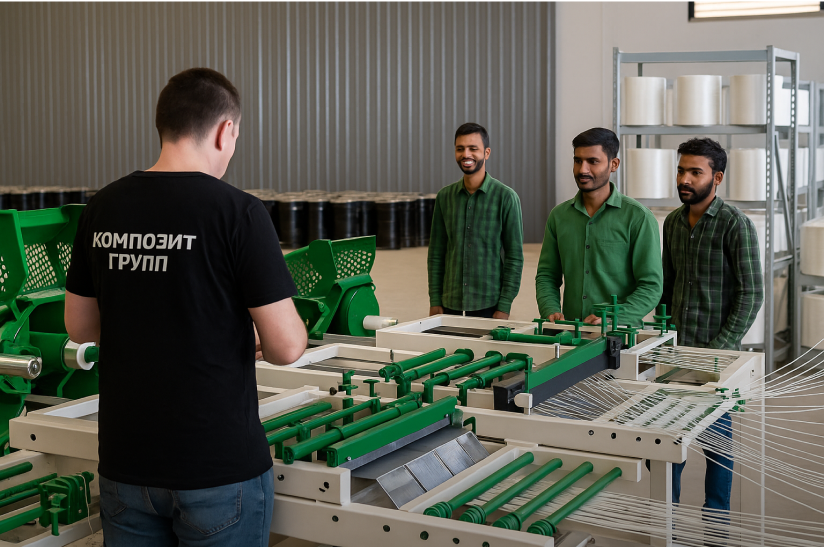
Fiberglass composite reinforcement with a nominal diameter of 10 mm, manufactured by LLC "Composite Group Chelyabinsk" — one of the largest producers of composite construction materials in Russia — was used for pile reinforcement.
Picture 1
Reinforced concrete piles with square cross-section. Manufacturer: Joint Stock Company "TZhBI-4"
Table 2 presents the physical and mechanical properties of the materials used in the calculations.
Table 2
Physical and Mechanical Properties of Materials
|
Parameter |
GFRP |
Steel |
Concrete B25 |
|
Elastic modulus, E (MPa) |
55,000 |
210,000 |
30,000 |
|
Poisson’s ratio, ν |
0.35 |
0.27 |
0.40 |
|
Density, ρ (kg/m³) |
2,000 |
7,800 |
2,500 |
Fiberglass composite reinforcement with a nominal diameter of 10 mm, manufactured by LLC "Composite Group Chelyabinsk" — one of the largest producers of composite construction materials in Russia — was used for pile reinforcement.